

What Is Lock Rekeying?
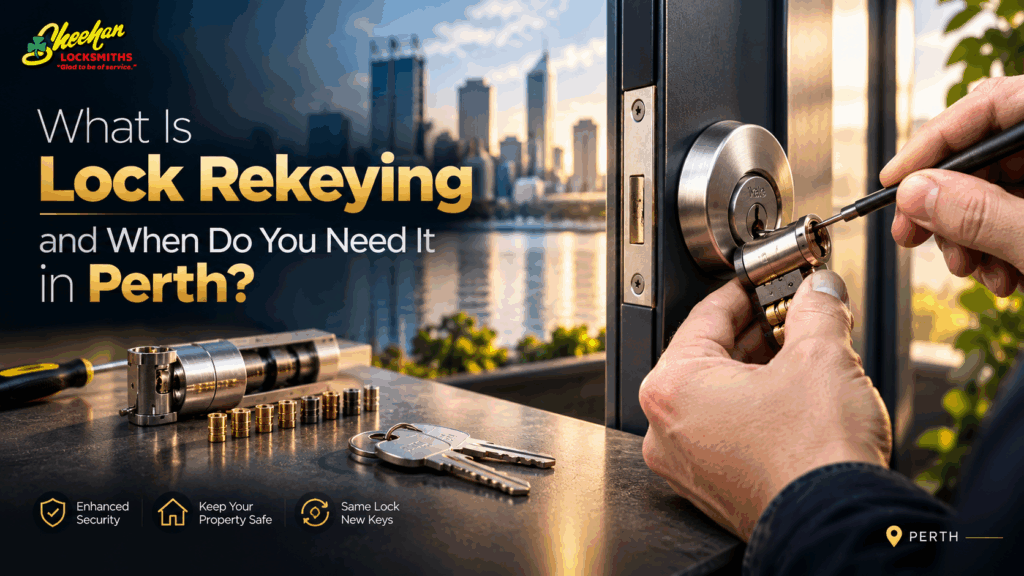
Lock rekeying is a way of changing how an existing lock responds to a key. Instead of taking the entire lock off the door and fitting a completely new one, a locksmith can often modify the lock cylinder so it works with a different key.
The easiest way to understand it is this:
The lock stays, but the key that operates it changes.
This can be useful when you are concerned that another person may still have a working key. For example, you may have recently moved into a house, lost a set of keys, or had a staff member leave a business without returning their key.
Rekeying is different from getting a duplicate key cut. A duplicate simply creates another key for the existing lock. Rekeying changes the lock’s internal setup so the previous key is no longer intended to operate it.
For Perth property owners, this can provide a practical way to regain control over access without automatically replacing every lock.
How Does Rekeying a Lock Work?
A standard mechanical lock contains a cylinder with small internal components that interact with the cuts on a key. The arrangement inside the cylinder determines which key can operate the lock.
When a locksmith rekeys the cylinder, the internal configuration is changed to correspond with a new key.
The general process may include:
- Inspecting the existing lock.
- Identifying the cylinder and lock type.
- Checking whether the hardware is suitable for rekeying.
- Opening the cylinder safely.
- Adjusting the internal components.
- Setting the lock to the new key.
- Testing the new key several times.
- Checking that the previous key no longer operates the lock.
The exact method depends on the manufacturer, cylinder design and condition of the hardware.
This is why rekeying isn’t simply a matter of cutting a different-looking key. The lock itself needs to be configured to recognise the new key.
Why Would You Rekey an Existing Lock?
People sometimes assume that a lock only needs attention when it stops working. In reality, access control is another important reason to consider a locksmith service.
You may want to rekey your locks when you no longer know exactly who has access to your property.
Think about how many people may have received a key over the years:
- Previous homeowners
- Tenants
- Property managers
- Family members
- Tradespeople
- Cleaners
- Employees
- Contractors
- Former business partners
You may have no practical way of knowing whether an old key was copied.
Rekeying gives you an opportunity to establish a new key arrangement without necessarily replacing every piece of hardware.
When Do You Need Lock Rekeying in Perth?
There are several situations where rekeying may be worth considering.
1. You’ve Recently Moved House
Moving into a new property is one of the most common reasons to review the locks.
Even if the previous owner gives you all the keys they have, you don’t necessarily know whether additional copies exist.
A spare key could have been given to a neighbour, relative, cleaner, gardener or tradesperson.
Rather than worrying about old copies, you can ask a locksmith to inspect the existing locks and determine whether they can be rekeyed.
This can be particularly useful when moving into a home in areas such as Perth CBD, West Perth, East Perth, Subiaco, South Perth, Victoria Park, Mount Lawley, Leederville, Scarborough, Morley, Bayswater, Rivervale and surrounding Perth suburbs.
2. Your House Keys Are Lost
Losing a key doesn’t always mean that you need a brand-new lock.
If you have lost your house key somewhere and aren’t confident that it will be returned, changing the key combination can be a sensible security step.
The important question is not simply:
“Can I get another key?”
It is:
“Could somebody else use the missing key to enter my property?”
If the answer concerns you, speak with a professional locksmith about whether your existing locks can be rekeyed.
3. Your Keys Were Stolen
A stolen key presents a different situation from a key that is temporarily misplaced.
If someone has deliberately taken your keys, you may not know whether they can identify the property they belong to.
In that situation, cutting another copy for yourself doesn’t remove the original access.
Depending on the lock, rekeying can make the old key ineffective while allowing you to continue using the existing lock.
If the lock is damaged or outdated, replacement may be the better choice.
4. You’ve Had a Change of Tenants
Property owners and property managers often need to think about key control between tenancies.
A tenant may have had additional copies made during their occupancy. They may have given a key to another person or misplaced one.
Before a new tenant moves into a rental property, it can be worth checking the condition and access arrangements of the locks.
However, rental properties in Western Australia have specific rules regarding locks and security devices. Consumer Protection WA states that landlords are responsible for providing and maintaining required security, and changes to locks generally require the appropriate consent between landlord and tenant.
So if you’re renting, don’t assume that you can simply arrange a lock change or rekeying without checking your tenancy rights and responsibilities.
5. An Employee Has Left Your Business
Businesses can have a much larger key-management problem than residential properties.
Imagine that an employee has worked at your Perth business for several years. During that period, they may have had access to an office, storeroom, rear entrance or other restricted area.
When they leave, returning the key is helpful, but it doesn’t prove that another copy doesn’t exist.
For businesses with sensitive areas or multiple staff members, rekeying can be considered as part of an access-control review.
This can apply to:
- Offices
- Retail stores
- Warehouses
- Workshops
- Medical practices
- Strata buildings
- Commercial properties
- Property management offices
A locksmith can also discuss whether a master key system or another key-management arrangement would be more appropriate for the property.
Is Rekeying the Same as Changing a Lock?
No.
This is one of the most important differences to understand.
Rekeying
The existing lock hardware may remain on the door while the internal cylinder is configured for a new key.
Lock Replacement
The existing hardware or cylinder is removed and replaced with another product.
For example, if your lock is physically sound but you have lost control of the keys, rekeying may be suitable.
If the lock is cracked, badly worn, unreliable or unsuitable for your security needs, installing new hardware could make more sense.
The correct choice depends on the condition and type of the lock.
When Is Lock Replacement Better Than Rekeying?
Rekeying isn’t the answer to every lock problem.
A replacement may be more suitable when:
The lock is badly damaged
If the cylinder or surrounding hardware has been physically damaged, changing the key configuration won’t necessarily fix the underlying problem.
The lock is worn out
Older hardware can become difficult to operate. You may experience sticking, loose components or inconsistent locking.
You Want Better Security
If your current lock doesn’t provide the level of protection you want, upgrading the hardware may be more useful than simply changing its key combination.
You Want a Different Lock Type
You may decide to move from a standard lock to a deadbolt, security lock or digital access solution.
In these cases, replacing the existing hardware can address both access and security concerns.
Can You Rekey Several Locks to Use One Key?
Sometimes, yes.
This depends on the lock types and whether the cylinders are compatible.
For example, a homeowner might have several exterior doors but wants to reduce the number of keys they carry.
A locksmith can inspect the existing cylinders and determine whether they can be arranged to operate from a common key.
This type of setup can be useful for:
- Front and rear doors
- Garage access
- Office doors
- Storage areas
- Commercial entrances
However, not every combination of locks can be made compatible. The hardware needs to be assessed first.
What About a Master Key System?
A master key system is different from simply making several locks work with the same key.
In a master key arrangement, different keys can be designed to provide different levels of access.
For example, in a commercial building:
- An individual employee may have access to one room.
- A manager may have access to several rooms.
- A building manager may have broader access.
This can make sense for commercial properties where different people require different levels of entry.
For larger Perth businesses, offices and multi-room properties, a locksmith can assess whether rekeying or a master key system is the more suitable option.
Does Rekeying Make a Lock More Secure?
It can improve key control, but it doesn’t automatically turn an ordinary lock into a high-security lock.
For example, if you move into a house and are concerned about old keys still circulating, rekeying can remove the previous key’s intended access.
But if the existing lock is physically weak, poorly fitted or heavily worn, changing its internal key configuration doesn’t solve those other issues.
Good property security should consider the complete entry point, including:
- Lock quality
- Door construction
- Door frame
- Strike plate
- Hinges
- Security screens
- Window locks
- Access control
- Key management
That’s why an inspection can be more useful than automatically choosing rekeying.
Lock Rekeying for Perth Rental Properties
Rental properties require extra care because landlords and tenants have responsibilities under Western Australian tenancy law.
Consumer Protection WA explains that rental properties must meet minimum security standards, including appropriate locks on doors and windows.
In most ordinary situations, tenants should discuss changes to locks or additional security with the landlord or property manager.
There are also special provisions for tenants experiencing family and domestic violence. In certain circumstances, a tenant can change locks without first getting the landlord’s permission, subject to the relevant requirements.
If you’re a Perth tenant considering rekeying, check your circumstances before arranging the work.
Lock Rekeying for Perth Homeowners
For homeowners, the decision is usually more straightforward because you control the property.
You may consider rekeying after:
- Buying a property
- Losing house keys
- Having keys stolen
- Ending a relationship
- Changing household arrangements
- Giving up access to a contractor
- Concern about old spare keys
- Wanting to simplify several locks
It can also be a convenient option if the existing hardware matches your doors and you don’t want to change the appearance of your property.
Lock Rekeying for Perth Businesses
Businesses should think about keys as part of their overall access management.
A key may provide access to more than just the front door. It could open an office, storeroom, cash-handling area, workshop or equipment room.
When staff or responsibilities change, reviewing who can access those areas becomes important.
Sheehan Locksmiths Perth can assist residential and commercial customers with practical locksmith and security solutions, including lock rekeying, lock repairs, lock installation, master keying and security upgrades.
The appropriate solution depends on the existing hardware and how the premises are used.
How Do You Know If Your Lock Can Be Rekeyed?
You normally can’t determine this just by looking at the outside of the lock.
A locksmith may need to identify:
- The lock brand
- Cylinder type
- Internal mechanism
- Condition of the hardware
- Existing key system
- Compatibility with the required key
If the cylinder is suitable and in good condition, rekeying may be possible.
If not, the locksmith may recommend repairing or replacing the cylinder or complete lock.
Should You Rekey All the Locks in Your House?
Not automatically.
Start by identifying which locks could be affected by the key you’re concerned about.
For example, if one missing key only operated your front door, you may not need to alter a completely separate lock that used a different key.
On the other hand, if the same key operates several entry points, you may want to review all of those locks.
A locksmith can help you work through the property’s key arrangement instead of simply replacing everything.
This can make the process more practical and avoid unnecessary changes.
What Should You Check Before Calling a Locksmith?
Before arranging a rekeying service, think about why you need it.
Ask yourself:
Have I lost a key?
If yes, consider whether somebody could identify your property from it.
Have I recently moved?
If yes, review who may have had access before you.
Has somebody left my business?
If yes, check whether they returned every key and whether copies may exist.
Is my lock already difficult to use?
If yes, replacement or repair might be more appropriate.
Do several doors use different keys?
If yes, ask whether your system can be simplified.
Having these details ready can help a locksmith understand what you’re trying to achieve.
Why Choose Sheehan Locksmiths Perth?
Sheehan Locksmiths Perth provides mobile locksmith and security services across the Perth metropolitan area.
The focus is on finding a practical solution based on the property, lock and customer’s requirements rather than recommending unnecessary work.
Services include:
- Lock rekeying
- Lock repairs
- Lock installation
- Emergency lockouts
- Car lockouts
- Master key systems
- Digital door locks
- Security upgrades
- Pool locks
- Door hardware
- Commercial locksmith services
Whether you’re located around Perth CBD, Subiaco, South Perth, Victoria Park, Cannington, Canning Vale, Willetton, Gosnells, Armadale, Joondalup, Wanneroo, Ellenbrook, Morley, Bayswater, Scarborough, Balcatta, Nollamara or another Perth metropolitan suburb, a local locksmith can assess your existing hardware and explain the available options.
Final Thoughts: When Should You Rekey Your Locks?
Lock rekeying is mainly about changing access to an existing lock.
It can be a sensible option when you have moved into a property, lost your keys, had keys stolen, changed tenants, had staff leave a business or simply want to regain control over who can use your locks.
The biggest advantage is that you may not need to replace the complete lock if the existing hardware is still suitable.
However, rekeying isn’t a universal fix. A damaged, worn or outdated lock may be better repaired or replaced.
For that reason, the best approach is to have the existing hardware assessed and explain what has happened. Sheehan Locksmiths Perth can then help determine whether rekeying, repair, replacement or another security solution is appropriate.
Frequently Asked Questions
1. What is lock rekeying?
Lock rekeying changes the internal configuration of a lock cylinder so it operates with a new key. The existing lock hardware may remain in place.
2. When should I rekey my locks in Perth?
You may consider rekeying after moving into a property, losing keys, having keys stolen, changing tenants or employees, or when you are unsure who still has access.
3. Is rekeying the same as replacing a lock?
No. Rekeying normally changes the key configuration of an existing lock, while replacement involves installing new lock hardware or a new cylinder.
4. Can every lock be rekeyed?
No. Rekeying depends on the lock type, cylinder design, compatibility and condition. A locksmith can inspect the hardware and advise whether rekeying is possible.
5. Can rekeying stop an old key from working?
Yes, when the lock is successfully rekeyed to a new configuration, the previous key should no longer operate that lock. If the lock is damaged or unsuitable, replacement may be recommended instead.

0 Comments